
The Bodhisattva Investor
I recently asked where are the ultra high agency bodhisattvas?
Where are those dedicated to reducing suffering, who can somehow channel that intention through real money, influence, or power? Do such people actually exist?
It turns out they do.
In response to my essay, practitioners, researchers, thinkers, mystics and even an aspiring bodhisattva reached out. The response was encouraging. One or two may well qualify as ultra high agency.
Through these conversations, a recurring question kept surfacing: beyond philanthropy, how is a bodhisattva supposed to deploy agency in a system built for profit, rather than cultivating love or wisdom?
It got me thinking. What sort of infrastructure might support an ultra high agency bodhisattva to deploy capital in service of their vow?
The root of the problem
To be clear, philanthropy is – somewhat sadly – essential to reducing suffering. It remains one of the few reliable ways to channel capital directly to the cause.
More broadly, directing capital into environmental and social impact is, and will continue to be, deeply important work (and happens to be the main area of work I’m immersed in right now).
But the roots of our meta-crisis sit further upstream. Our environmental and social crises will only begin to improve at scale, when we, as a species, awaken to deeper forms of knowing and finally reckon with the interconnectedness of all things.
Our meta-crisis is, first and foremost, a spiritual crisis.
And if that’s true, then the bodhisattva investor’s task is not only to treat the symptoms, but to aim at the root, directing capital toward the place where transformation actually begins: individual cultivation of wisdom, meaning, and what I will call for the purposes of this exploration, spiritual impact.
So how might we empower the bodhisattva investor?
What follows is a thought experiment, just one person’s approach to offering up a conceptual framework for investing in spiritual impact. I’m acutely aware that capital alone cannot solve the meta-crises, nor is it even the starting point, but that doesn’t mean we should ignore it as a tool. So I offer this essay to spark discourse, push the frontiers of my own thinking, surface my blind spots, and act as a beacon for others exploring a similar terrain. And, if it resonates, attract more like-minded, high-agency leaders and doers to Speira, our conscious community exploring these kinds of inquiries.
Investing in spiritual impact
Attempting to direct capital in service of good is not a new challenge. We’ve already had decades of meaningful work on environmental and social impact. It’s been a long road, full of detours and false starts, but real progress has been made. Capital allocated to impact investing has been growing at over 20% per year.
Across the ecosystem, new standards, verification bodies, biodiversity and nature markets, and capital structures are emerging. They form a maturing architecture capable of channelling capital toward meaningful change.
Alongside these great efforts, frontier thinking from groups like TransCap and Dark Matter Labs are pushing even further, exploring the systems-level redesigns required for a regenerative, life-supporting economy.
If you’re a high agency bodhisattva, I encourage you to immerse yourself in their work to deepen your understanding of how transformation actually takes root.
But in this essay, I am exploring something more esoteric, more niche1.
For all our progress, our economic systems still overwhelmingly incentivize and reward productivity, scale, and profit above all else. The result is an economy optimized for such things as attention capture, short term dopamine fixes, and spiritually empty consumption.
So this raises a deeper question for the boddhisatva investor: what would it actually look like to invest in spiritual impact?
If the phrase “spiritual impact” doesn’t feel quite right for you, we can just as easily speak of “wisdom impact” or “consciousness impact”. What I’m pointing to is an apparatus that supports our collective journey into deeper forms of knowing, a lived sense of the interconnectedness of all things, and an integration of the intuitive, the relational, and the sacred into our worldview.
What to invest in
To explore this properly we need a few working definitions. What activities actually count as ‘high in spiritual impact’?
Broadly, they might be ones that help us work on ourselves. Because after all, working on ourselves is, in fact, the ultimate form of doing something in service of love.
Activities that qualify might include those that deepen our presence, help us see ourselves more truthfully, open us to the felt reality of interconnectedness, and support the ongoing work of bringing the self into ‘right relationship’ with the whole.
In practice, this includes the full spectrum of contemplative and transformative work: meditation, breath work, embodiment disciplines, psycho-spiritual modalities, psychedelic-assisted therapies, apprenticeships in wisdom traditions, and simply healthier, more intentional ways of living.
Here are some not-that-far-out examples:
- Education institutions and curriculums that teach an ecology of practices that help people build routines that support the growth of wisdom.
- Integrated health and wellbeing hubs that combine physical care with psychological, spiritual and self-development.
- Physical spaces for transformation where wisdom is woven into daily life, such as residencies, dialogos circles, or even a network of modern monasteries designed for contemporary seekers.
- Wisdom-based career pathways and apprenticeship programs.
- New therapeutic modalities blending somatic, contemplative, and psycho-spiritual methods.
- Technology that repurposes dopamine mechanics to train attention, emotional regulation, breathwork, or awareness (something like a healthy TikTok).
- Integration services that translate profound experiences like psychedelic-assisted breakthroughs into embodied daily life.
- Contemporary wisdom communities (“new churches”) such as Speira or The Leading Edge.
This isn’t meant to be a complete list. Each activity would need to be assessed on its own merits, ideally through a systems-level theory-of-change lens, to understand the spiritual impact it might help to create.
Lacking in spiritual depth
To be fair, the last few decades have already seen a surge in things that look spiritually impactful: the health and wellness boom, yoga, mindfulness and meditation, the rise of self-help and coaching, the psychedelic renaissance, and a wave of new therapeutic modalities. There is clearly a hunger for deeper ways of knowing.
But much of this has suffered through the process of being commodified for scale, packaged as quick fixes, or detached from place and culture, and sadly, is teeming with grifters and opportunists.
The practices themselves matter, but integrity around them is often lacking, and it’s not super easy to sift through everything and develop a high integrity, accessible ecology of practices.
In many cases the activities themselves still lack real depth.
Take mindfulness. Despite its explosive growth, most modern versions extract only the meditative technique, and discard the ritual and animist elements as expendable2. As a result something essential is lost.
We see the same pattern elsewhere. Some examples are relatively benign, such as yoga stripped of its lineage, or breath work reframed as a biohacking tool. Others are outright dangerous, like plant medicine being commercialised without consideration to preparation, ceremony or integration.
Which leads to a deeper realization: Spiritual impact depends far more on the who than the what.
Who to invest in
What is being done is important. But much more depends on who is doing it. The depth of any spiritually impactful endeavour depends heavily on the consciousness of its leaders: their inner alignment, their ability to draw on deeper ways of knowing, their capacity to act from a place beyond egoic reactivity.
Without spiritually integrated leaders, even sincere efforts to make a spiritual impact can drift off course.
For the kinds of leaders a bodhisattva investor would want to back, the healthiest would be those who are as much as possible operating from a state of theonomy3: agency aligned with a higher, wiser coherence than the personal self.
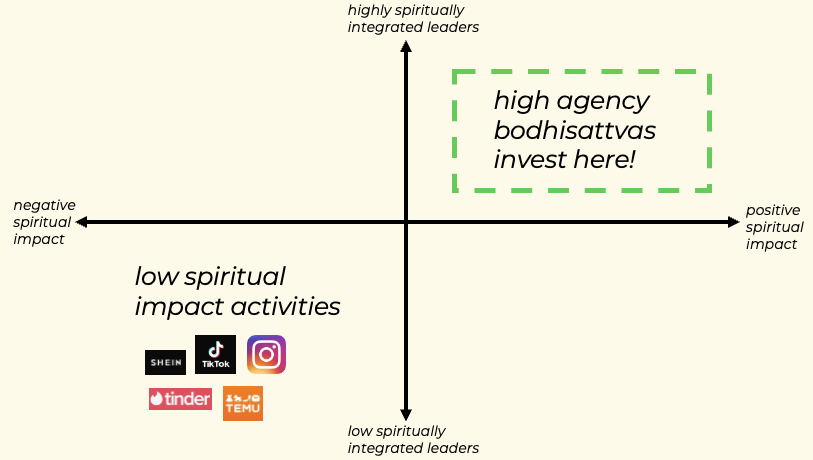
To gauge this, we need a way to evaluate the doer as well as what’s being done. Our boddhisatva investor framework therefore needs two dimensions: the what (spiritual impact) and the who (how spiritually integrated4 a leader is).
Fortunately, there are already many thoughtful attempts to articulate and even quantify how spiritually integrated a leader might be. They may be imperfect, but they point to language we can begin to build consensus around.
An example is Tapuat, who run a ‘Heartful Leadership Assessment’ which covers domains like presence, inner peace, dharma (purpose), inner joy, non-attachment, selflessness, and unity. I took the assessment myself, and the resulting profile showed me both tendencies and blind spots (my ‘non-attachment’ score came in lowest, which… unfortunately tracks. I’m working on it.)
Another interesting approach is 432hz by Amon Woulfe, which maps the inner landscape through a combination of introspection and biological markers. Given it’s quite a bit more comprehensive I’ve not tried it yet, but their “In Tune Experience” pairs self-assessment with biological diagnostics: eg, an Oura Ring for sleep and nervous system regulation, and a Cortisol Awakening Response (CAR) test that maps stress patterns throughout the day.
The pairing of subjective data (like self reported surveys) and objective data (like biomarkers) fascinates me, for a couple of reasons:
- It reveals coherence, or the lack of it - if someone self reports high inner peace but their cortisol spikes all day, there’s a mismatch worth exploring.
- It hints at how biometrics might be one way to scale spiritually integrated leadership - if leaders with regulated nervous systems consistently make better, longer-term decisions, then spiritually integrated leadership might become economically rational?
These tools are young but they’re pointing in a promising direction. A meaningful assessment would likely require periodic readings.
But after all, many of us won’t hesitate to do an annual health check, why not a spiritual one?
Of course none of this is immune to gaming or manipulation. But that’s not a reason to avoid building these tools. Better to move in a direction where we have more reliable ways of understanding how spiritually integrated a leader might be, than none at all.
Once we develop some consensus around what a spiritually integrated leadership looks like, we can see where capital might flow for the highest spiritual impact. This takes us to the top-right quadrant of our framework.
The framework is oversimplified, of course, but useful. If a high-agency bodhisattva wanted to invest in activities that genuinely reduce suffering, supporting individual awakening would be one meaningful path. To do that with conviction, they would need infrastructure that allows capital to flow not only into spiritually impactful activities, but (perhaps most importantly) into the most spiritually integrated people leading them.
How to ensure integrity
With both the what and the who in view, we can now ask: how do we ensure the integrity of spiritual impact?
This is where governance matters.
A bodhisattva investor would need structures that protect the integrity of spiritual impact. One possibility is a trusted council of wise leaders from different domains: spiritual and philosophical traditions, Indigenous elders, lineage holders, and seasoned practitioners. Their role would be to discern what qualifies as genuine spiritual impact, and to safeguard the integrity of what gets built.
In fact, access to such wise elders already appears to be happening in small but meaningful ways.
I came across a recent post from the first spiritual teacher who I credit with beckoning me out of a decade of materialism. Shinzen Young is leaving his life long vocation as meditation teacher to take an advisory role with biotech venture Sanmai who develop frontier therapeutics for mental health conditions, “to work on Focused Ultrasound as a possible accelerator to Equanimity”.
This feels like a living example of what genuine spiritual governance might look like: the deep, hard-won wisdom of a lifelong practitioner paired with modern tools that hold real potential for meaningful spiritual impact through supporting individual transformation at scale.
Pause on that for a moment. When I began writing this piece, I wasn’t sure anything even close to this kind of pairing existed. Shinzen Young on a biotech advisory board was honestly, unimaginable.
So this is perhaps one of the first places we can support our ultra high agency bodhisattva investor: by building the governance needed to discern where real spiritual impact can be made, and by entrusting its depth and integrity to the wisest hearts and minds.
A nod to the impact of the scientific revolution
Under this framework it’s also interesting to consider the remaining quadrants. Bear in mind this is not meant to map the whole world, only to offer a lens on those with ultra high agency:
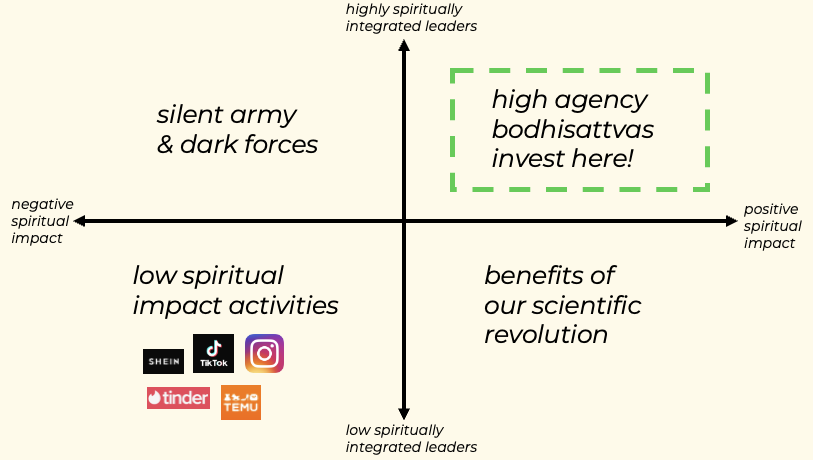
Top-left: spiritually integrated leaders contributing to negative spiritual impact
In the top left, people are aware, even awake, but stuck. They are high agency but contribute to products or services that have negative spiritual impact.
This could include senior executives, entrepreneurs, and movers and shakers whose identities are so tightly bound to their roles that they can’t imagine stepping outside them. Others might be heirs to old money or political families, bound by cultural or familial rules.
Many high agency people may simply lack a path, community, or support system that would make the necessary inner and outer change in their world possible.
Investment in spiritual impact could have extraordinary leverage here. Even modest infrastructure such as career pathways focused on wisdom, communities of practice, mentorship, could help this “silent army” migrate into the top-right.
If you recognize yourself in this quadrant, you may find a community like Speira worth exploring.
The dark forces
In the top left, we also have those who absolutely know how deeper access to reality works, but choose to bend it toward self-interest. People who harness these higher capacities in service of greed, domination or fear. No doubt in this category exist certain tech founders, politicians, influencers, and cultural elites.
In certain cases it isn’t even subtle: we see some of our worlds biggest creeps openly fascinated by dark magic for example.
Bottom-right: benefits of the scientific revolution
This quadrant is more complex. It captures the benefits of spiritual impact (mostly as a second order effects) delivered by our rationalist, post-scientific revolution world.
We cannot underestimate the extraordinary impact of scientific and technological advances that have reduced suffering immeasurably, and in turn allowed for spiritual impact. Case in point: I would not even be able to write this essay without access to clean water, electricity, physical safety, food and shelter, and a civilized society.
Capitalism, science, and technology have saved and uplifted lives on a scale unimaginable in any previous era. Big pharma, for all it’s darkness, also cures rare and painful diseases. Modern agriculture feeds millions who would otherwise starve. Clean water, reliable electricity, sanitation, these things prevent unthinkable suffering and quietly raise the baseline of human dignity.
Material progress has dramatically reduced suffering.
What it hasn’t done is deepen our collective access to wisdom, meaning and purpose, or our capacity to inhabit reality with depth. This is why we find ourselves staring into a multi-decade meta-crisis, and the very gap our simple thought experiment is trying to illuminate.
What next?
Maybe this framework could be used as a thought exercise for writing an investment mandate, maybe a new kind of venture capital thesis oriented toward high spiritual impact.
Philanthropic capital will almost certainly be needed to catalyze the market of high spiritual impact products and services, perhaps from the right high agency bodhisattva investor?
Ultimately, wouldn’t it be amazing to see measures of spiritually integrated leadership start to show up inside public companies? Maybe not framed explicitly in this type of language, but possibly through proxies like biomarkers or leadership ‘inner-state’ baselines.
It isn’t easy to build something within the existing system that’s meant to heal the system itself.
As I wrote in my previous essay, left-brain approaches are necessary but not sufficient. And most importantly, change always begins with the self. Everything else follows from there.
My hope is that conversations like this can act as bridges toward the world that’s coming, one that integrates our material brilliance with the spiritual maturity that’s been left behind.
If any of this resonates, I’d love to hear your feedback and continue the conversation. You can always reach me through Speira.
Contemplating how our world might better pursue wisdom and spiritual insight wasn’t always niche. In ancient Greece the cultivation of philosophical insight was considered a central civic duty, not a fringe pursuit. It’s really only in our post-modern world with its fixation on materialism that the work of ‘becoming wise’ has been pushed to the margins. ↩
An overview of how modern mindfulness is removed from it’s original context is artfully covered in this The Emerald podcast:
“In recent years, the practice of ‘mindfulness’ has become ubiquitous. Yet modern iterations of mindfulness practice often live removed from their original context. The forest ecology from which mindfulness grew was animate and alive, and what we call mindfulness practices formed only a part of a rich tapestry that included rituals of ancestor worship, enacted connection to ecology, spirit mediumship, healing, and esoteric somatic practices. Modern adoptions of mindfulness tend to view the solitary meditative aspects of practice to be the ‘essential’ part, whereas the ritual and animist elements are seen as expendable. The reasons for this are deeply tied in with colonial history, and with the western legacy of body-mind divide. For it turns out that the animate, ritual context is profoundly important for shaping and architecting relational minds. In an age of fracture, is being mindful of an already fractured mind enough? Or is a more robust vision necessary? As science increasingly comes to recognize the importance of the context that traditional cultures have understood for thousands of years, we come to understand that minds need a contextual body. Mind needs fire and water, breath and movement, it needs story and song... it needs to establish a living relationship with those that came before and those yet to come, to offer in devotion and to repeatedly enact its place in the larger cosmos. Such realizations return us to the sacredness of... form. We find that all of the supposedly ‘non-essential’, ritual, form-based aspects of tradition actually architect a mind that has true fullness to it, and perhaps we can’t find true fullness of mind without ritually placing the mind in living context.” ↩
Vervaeke uses the word theonomy to describe building a deep relationship with reality (“the sacred”) that actually strengthens our sense of agency instead of diminishing it. It’s different from the old religious idea of being ruled by divine law. If autonomy means being guided by yourself and heteronomy means being guided by others, then theonomy means being guided by something greater than the self ie. the divine. ↩
By spiritually integrated, I mean leaders with genuine inner alignment, those whose actions flow from presence and clarity rather than egoic reflex, and those who embody a lived sense of interconnectedness. I’ve shared a few frontier approaches for assessing these qualities, but the field is much broader than I have got my arms around, or than I can summarise here. For very practical approaches, this initiative, however, provides one of the clearest and most practical explorations of what spiritual integration in leadership can look like on the ground. ↩
Member discussion