
A species of awakened beings
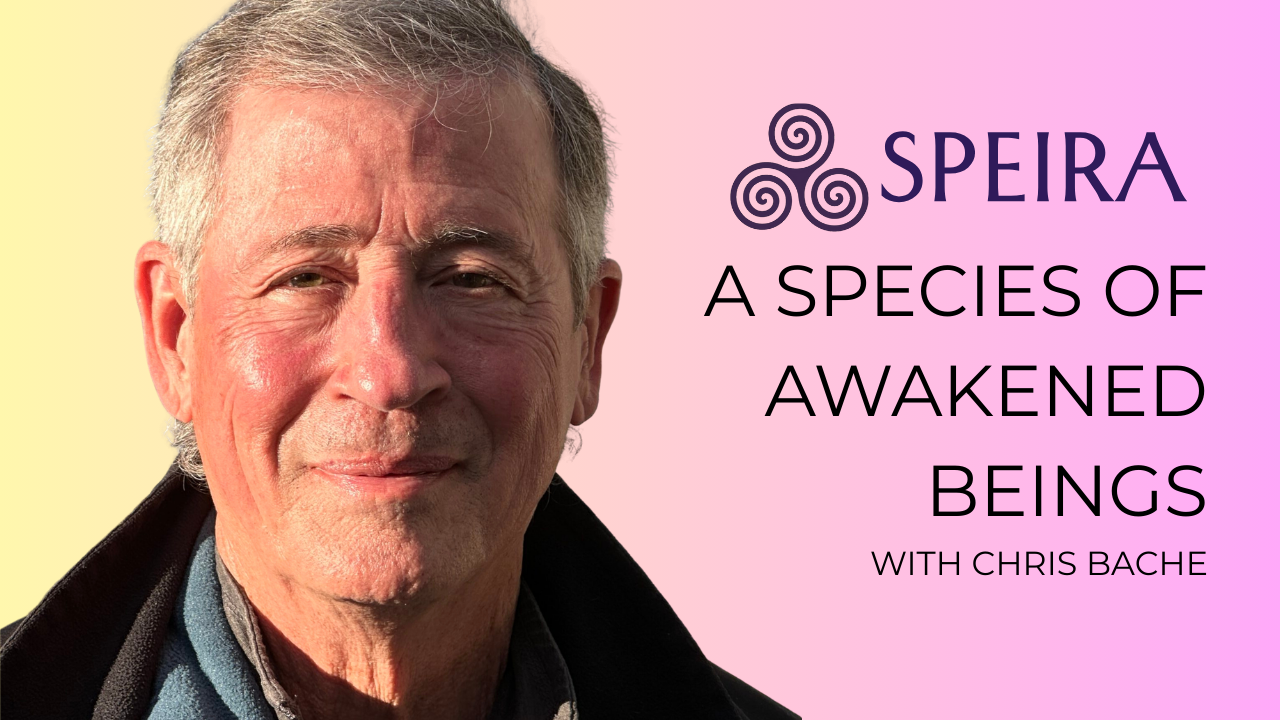
In preparation for the Speira book club with Chris Bache next week, I had the honour of a long, unhurried conversation with him, one I’ve been turning over ever since.
Chris is a philosopher and Professor Emeritus of Religious Studies, but that framing barely captures what he actually is: a serious, methodical explorer of the furthest reaches of consciousness and the nature of reality itself. His book LSD and the Mind of the Universe distils the insights from over two decades of carefully undertaken, high-dose psychedelic sessions.
Some psychonauts are content with self-therapy, or spiritual realization. Instead, Chris embarked on a rigorous programme of cosmological inquiry. Before the obvious question arises, Chris addresses it directly:
There are more ways to do the psychedelic path wrong than there are to do it right.
And yet he is not a man who traffics in fear. The counterweight to that warning is an invitation to trust:
Trust the depth of the inner healer, trust the process. If you let it take you where it wants to take you, it will culminate in a process where you will have a breakthrough, and it will carry you through.
What makes Chris’s multi-decade journey distinct is that he wasn’t primarily seeking personal healing or spiritual awakening. He was pursuing an understanding of the nature of reality itself. And what opens when you pursue that, he explains, is far less forgiving:
LSD is an evolutionary accelerator. It’s an amplifier of consciousness, and when you amplify consciousness, it spontaneously detoxifies itself. If you wanted to stop at just spiritual awakening, the process could end more quickly and be more gentle. But cosmological exploration is something different.
This is a conversation worth listening to more than once. There is a depth in Chris that is rare. Each sentence is load bearing, the meaning of his chosen words carry the unmistakable signature of being arrived at through experience.
Chris's worldview rests on several foundations: a universe that is intelligent and benevolent, reincarnation, and the idea that existence has a clear evolutionary direction. From there, we discuss the hardest questions: if the universe is fundamentally loving, what do we do with suffering that seems entirely unnecessary?
To come to the conclusion that some suffering is unnecessary, we have to have a certain understanding of what the purpose of creation is – what the project of it is. And I think in order to have that, we have to look very very deep. Because the intelligence of the universe does not think small, it doesn’t think in terms of what’s good for individual beings, it thinks in terms of whole species, whole ecosystems. And it doesn’t think short, it’s not thinking in terms of 100, 1,000 or 10,000 years. Its thinking in terms of millions or billions of years. Before we could say ‘no compassionate God would allow this suffering’, it means we think we know what the project is. What if the process that humanity is in is not 90% complete, with only 10% remaining. What if it’s only 10% complete with 90% remaining?
It’s a framing that, for me, is difficult to hold. But Chris isn’t asking us to accept it intellectually, he explicitly points this out. He is not making a philosophical case to be weighed and assessed. He is pointing to what he has seen, and reporting back from somewhere much further out.
What he saw, beyond the suffering, was this:
The true goal (of creative intent) is to bring full spiritual consciousness, full cosmic power inside time and space. To touch into transcendence, to touch into these realities is an important stage of the developmental cycle, but its only the first half. The second half is bringing that intensity, that awareness into your human existence, and let it change your entire physical existence. Not only our entire physical spiritual, mental and intellectual existence, but to change our body – our molecular structures of our body – and to change our social existence. Some would say ‘that’s just an idealistic dream, how could we ever bring that about?’ and I think we could never bring that about. But I think nature’s working very hard to bring this about, and the intelligence that’s built into nature is working hard to bring this about, and that we are in a cooperative relationship with that nature. And just as a mother, when she gives birth to that child, she doesn’t ignore her suffering, but she forgets the suffering out of the joy of the birth of the child. When the future human is born, we will look at the long history of suffering that’s brought us to this culmination point, and we will say ‘its worth it’.
I asked a simple and perhaps impossibly difficult question: how do we practice love in a complex world? His answer, by having the courage to do what we already know:
I think the most important question is not primarily ‘what do we do’, the bigger question is ‘will we have the courage to do what we know we can do’. And that is going to be different for every person, every circumstance. If we commit ourselves to finding what the demands for love are, and the opportunities to love are in our specific circumstances, then we will find the resources within us and around us to actualize that potential. It may not look like what the person next to us is doing, but it will share the common ground of actualizing the potentials that are built into the fabric of our incarnations.
And underpinning all of it is Chris’ vision of a species of awakened beings, and our role in bringing that about sooner rather than later:
The more we understand (the challenges in this transformational time in history) the more we can invest in the solutions. If we don’t understand what’s happening we’re going to invest in the problems. If you have a capacity to bring about change in our culture, in our civilization, we can accelerate the change, soften the trauma and move more quickly to a positive outcome.
But understanding alone isn’t enough. What we act from is just as consequential as what we act toward, and on that, Chris draws a distinction that I haven't been able to stop thinking about:
Once you experience the Divine love, then naturally that leads you to become a servant of justice, fairness, compassion in the world. But its different to do it out of a sense of deficit than out of a sense of surplus. So it’s not out of a sense of there is a deficit in reality, but there is a deficit in manifestation.
The hard questions don’t really resolve cleanly. Chris might say, that is precisely the point. These aren’t questions the intellect can close. They have to be lived into, over years, at considerable cost. Chris himself is the most persuasive argument for what that living can produce:
It’s an experience which has changed my assessment and changed my tolerance of suffering, because I have a certain sense of the enormity and the magnificence of the creative project.
Ultimately, the most compelling argument Chris makes is not an argument at all: it is him. Spending time in his presence, even through a screen, leaves something behind: a quietly altered sense of the scale of what we are part of, a compassionate urgency, and, unexpectedly, a warmer relationship with the weight of being here at all.
You can find the full conversation here. I hope you enjoy it.
- 0:00:53 – LSD and the Mind of the Universe
- 0:03:47 – Awakening vs cosmological exploration
- 0:09:55 – The practical implications of undertaking cosmological exploration
- 0:14:57 – What gives psychedelic experiences epistemic authority?
- 0:23:50 – Who decides what you see?
- 0:29:33 – Are entities and spirits real in their own right, or symbolic ways of relating to something deeper?
- 0:35:43 – How to balance meditation and contemplative insight with intense psychedelic insights?
- 0:41:05 – Did you ever fear for your sanity?
- 0:44:18 – A vision of profound suffering for humanity
- 01:00:30 – The contrast of suffering as a path to higher realities
- 01:10:55 – The fundamental paradox of the nature of suffering
- 01:21:59 – Asking about the incomprehensible
- 01:29:14 – Reconciling the perfection of being with the imperfection of becoming
- 01:35:21 - Voluntary vs involuntary reincarnation
- 01:46:34 – How do we practice love in a complex world?
- 01:48:26 – Speed round
Speira is a private, conscious community of leaders, founders, thinkers and mystics committed to expanding consciousness and exercising meaningful agency in the world.
Our world is in desperate need of credible, optimistic, post-materialist worldviews. Ones that transcend and include materialism, honouring all that the scientific revolution has given us, while recognising that it has been necessary but not sufficient for what comes next.
Speira is at the forefront of this discovery process. If you’re interested in joining Speira, you can learn more here.